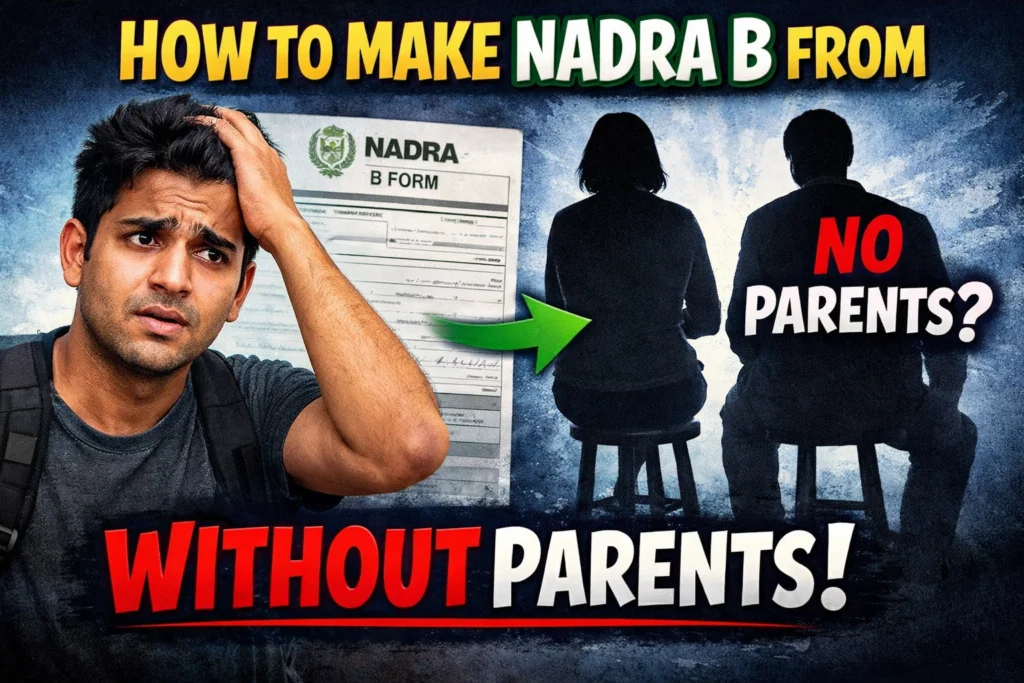
Identity is a fundamental right for every citizen, regardless of their age or family circumstances. In Pakistan, the Child Registration Certificate (CRC), commonly known as the B-Form, is the primary identity document for individuals under the age of 18. It is a mandatory requirement for school admissions, obtaining a passport, and eventually securing a Computerized National Identity Card (CNIC).
Under standard procedures, obtaining a B-Form is straightforward. Parents visit a National Database and Registration Authority (NADRA) center with their CNICs and the child’s birth certificate. However, life does not always follow standard procedures. Many children find themselves in situations where their parents are deceased, unknown, or legally absent.
For guardians, relatives, or heads of orphanages, navigating the bureaucratic maze to register a child without parental presence can feel overwhelming. The good news is that NADRA has specific protocols in place to ensure these children are not left undocumented. This guide outlines the legal requirements and step-by-step process for obtaining a B-Form when parents are not in the picture.
Role of a Legal Guardian
The core concept you must understand when applying for a B-Form without parents is guardianship. NADRA’s system is built on family linkage. Usually, a child is linked to their father and mother. When those links are unavailable, the system requires a substitute authority figure a legal guardian to take responsibility.
You cannot simply walk into a NADRA center claiming to be a child’s aunt, uncle, or grandparent and register them. Even if you are a direct blood relative and the child lives with you, the state requires legal proof that you are the appointed guardian of that child. This prevents fraud and protects the rights of minors.
Therefore, the process of getting a B-Form without parents often begins outside of NADRA, usually in a courtroom.
Step 1: Obtaining a Guardianship Certificate
Before you visit a NADRA registration center, you must establish your legal authority to act on behalf of the child. If the parents are deceased, the authority does not automatically transfer to the next of kin without documentation.
You need to apply for a Guardianship Certificate from a competent court of law. Here is how that generally works:
- File a Petition: You must file a petition in a Guardian Court (or Family Court exercising the powers of a Guardian Court) under the Guardians and Wards Act.
- Submit Evidence: You will need to provide evidence of the parents’ death (Death Certificates) or absence, and proof of your relationship to the child.
- Court Decree: If the court is satisfied that your guardianship is in the best interest of the minor, it will issue a Guardianship Certificate or a Court Decree appointing you as the legal guardian.
This court order is the most critical document in your application. It replaces the requirement for parental CNICs.
Step 2: Prepare the Necessary Documents
Once you have the legal authority settled, you need to compile the paperwork. Showing up with missing documents is the most common reason for rejection at NADRA centers.
Ensure you have the following original documents and a set of photocopies:
- The Court Decree/Guardianship Certificate: As discussed, this is mandatory.
- The Guardian’s CNIC: Your own identity card must be valid (not expired).
- Proof of Birth: This is usually a Birth Certificate issued by the Union Council. If the child does not have one, you will need to get a “Late Entry of Birth” certificate from the Union Council, which may also require the same Guardianship Certificate you procured for NADRA.
- Parents’ Death Certificates (if applicable): If the parents have passed away, their death certificates issued by the Union Council are required to close their files and establish the orphan status of the child.
- Affidavits: In some cases, NADRA may request a stamped affidavit confirming the details of the child and the guardian’s responsibility.
Special Case: Orphanages and Care Centers
If a child is abandoned or residing in an orphanage, the head of the institution acts as the guardian. In this scenario, the requirements shift slightly:
- The head of the orphanage must provide their own CNIC.
- Registration documents of the orphanage/institution.
- A letter on the institution’s letterhead stating the child is under their care.
- A court order may still be required depending on the specific case and the age of the child.
Step 3: The Application Process at NADRA
With your documents ready, you can proceed to the NADRA office. It is advisable to visit a Mega Center if one is available in your city, as they often have dedicated counters and operate 24/7, though standard centers can also process B-Forms.
1. Issuance of Token
Upon arrival, go to the reception or token counter. Explain clearly that you are applying for a B-Form for a child under your legal guardianship. You will be issued a token number.
2. Data Entry and Photograph
When your number is called, proceed to the data entry counter. The Data Entry Operator (DEO) will ask for your CNIC and the Guardianship Certificate.
- They will enter the child’s details (Name, Date of Birth, Place of Birth).
- They will take a photograph of the child.
- Crucial Step: Ensure the DEO links the child to you as the Guardian, not as a parent (unless you have legally adopted the child and the court order specifies parentage change, which is rare and complex in local law). The form should reflect “Guardian” in the relationship column.
3. Biometric Verification
As the applicant and guardian, you will be asked to provide your fingerprints. This authenticates the application and legally binds you to the data provided. If the child is over a certain age (usually 10+), their biometrics may also be taken, though this varies by current policy.
4. Form Review and Attestation
Once the data is entered, the operator will print an application form. Review this document carefully. Check the spellings of names and dates of birth. Mistakes made here are difficult to fix later.
In standard applications, a gazetted officer (Grade 17 or above) must attest the form. However, since the biometrics of the blood relative/guardian are present, some centers may waive this if the biological parents are verified in the database as deceased. If attestation is requested, you will need to take the form to a gazetted officer (like a school principal or doctor) and return it to the center.
Step 4: Collection
After submitting the form and paying the fee (which varies depending on whether you choose Normal or Executive service), you will be given a receipt with a tracking ID.
- Executive/Urgent: Usually processed within 7 to 15 days.
- Normal: Usually processed within 15 to 30 days.
Keep the token receipt safe. You will need to show it to collect the printed B-Form.
Dealing with “Unknown” Parents
A more difficult scenario arises if a child is found abandoned and the identity of the parents is completely unknown.
In 2014, the Supreme Court of Pakistan passed a landmark ruling facilitating the registration of orphans with unknown parentage. In these cases, the head of the orphanage or the person who found/adopted the child becomes the legal guardian.
For the column of “Father’s Name,” which cannot be left blank in the database, NADRA allows the guardian to assign a name. This name is for identification purposes in the database and does not necessarily imply biological lineage, ensuring the child can still receive an identity without the stigma of a blank parentage column.
Common Challenges and Tips
- Biometric Failures: If your fingerprints (as the guardian) do not scan, update your own fingerprints at NADRA before applying for the child.
- Name Mismatch: Ensure the child’s name on the Union Council Birth Certificate matches exactly with what you want on the B-Form. NADRA rarely deviates from the Union Council document.
- Go Early: NADRA centers are notoriously busy. Arriving early in the morning can save you hours of waiting.
- Bring the Child: The child must be physically present for the photograph. You cannot apply with just a passport-sized photo of the child.
Securing Their Future
Obtaining a B-Form without parents is undeniably more rigorous than the standard process. It involves courts, legal paperwork, and extra scrutiny. However, this rigor serves a purpose: it protects the identity and lineage of the child.
By securing this document, you are opening doors for the child’s education, health, and travel. It is the first step toward giving them a recognized place in society. If you find yourself stuck, do not hesitate to ask for the “In-Charge” or Manager at the NADRA center, as they are often better equipped to handle non-standard cases than the counter staff.