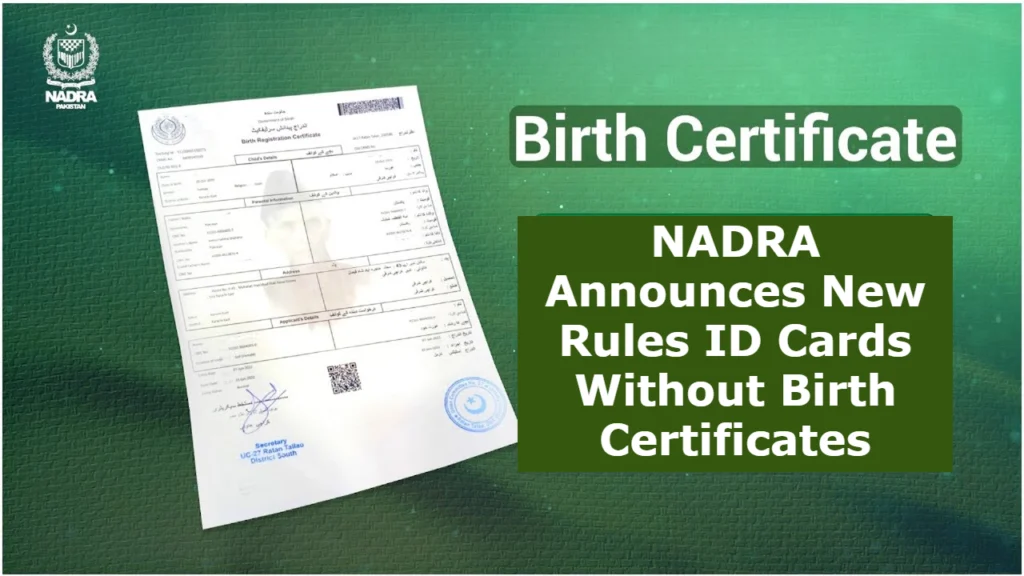
The National Database and Registration Authority (NADRA) has introduced a new facility that allows Pakistani citizens without birth certificates to obtain national identity cards under specific conditions. This marks a significant policy shift aimed at addressing long-standing documentation gaps that have prevented many citizens from accessing essential services and exercising their rights.
Nadra Birth Certificate Requirement
The facility, which came into effect following approval from NADRA’s Authority Board and on the directive of Interior Minister Mohsin Naqvi, will remain available until December 31, 2026. The initiative operates under the framework of the NADRA Ordinance and existing national identity card regulations.
For countless Pakistanis who lack formal birth documentation, this policy change opens doors that were previously closed. The ability to obtain a national identity card is fundamental to accessing banking services, registering for mobile phone connections, voting, and securing employment activities that many have been excluded from due to documentation barriers.
Who Qualifies for the New Facility?
NADRA has established clear eligibility criteria for first-time registrants seeking identity cards without birth certificates. The requirements differ based on gender and marital status, reflecting the authority’s effort to verify identities through alternative means.
Requirements for Married Women
Married women aged 18 or above must provide a marriage certificate as proof of their marital status. Additionally, their father or mother and husband must hold valid identity cards registered with NADRA. Biometric verification of the relevant family members will be mandatory to confirm relationships and prevent fraudulent applications.
Requirements for Unmarried Women
For unmarried women, the conditions relating to a husband naturally do not apply. These applicants must still meet the age requirement of 18 years and provide evidence of their parental relationships through the identity cards of their father or mother.
Requirements for Men
Men aged 24 or above seeking their first identity card must present the identity card of at least one parent and one sibling. Biometric verification of one parent will be required to establish family connections and authenticate the application.
Special Provisions for Deceased Family Members
NADRA has made accommodations for applicants whose parents or spouse have passed away. If both parents and the husband are deceased but their records exist in NADRA’s database, the biometric verification requirements may be waived. This provision recognizes the practical challenges faced by individuals who have lost immediate family members but still need access to official documentation.
Identity Verification Through Alternative Methods
Without birth certificates to rely on, NADRA will employ alternative verification methods to confirm applicants’ identities. The biometric verification of family members serves as the primary tool for establishing relationships and preventing identity fraud.
This approach leverages NADRA’s extensive database of registered citizens and their biometric information. By cross-referencing family connections through existing records and conducting biometric verification, the authority can build a reliable picture of an applicant’s identity without traditional documentation.
The verification process aims to balance accessibility with security. While opening doors for undocumented citizens, NADRA must also guard against potential misuse of the system by individuals attempting to obtain fraudulent documents.
What Type of Card Will Be Issued?
First-time applicants approved under this facility will receive a non-smart national identity card free of charge. This removes the financial barrier that might otherwise prevent economically disadvantaged citizens from obtaining essential documentation.
The non-smart card provides the fundamental identification capabilities that citizens need for daily life, even if it lacks some of the advanced features found in smart cards with embedded chips.
Permanent Information: No Changes Allowed
NADRA has emphasized that citizens must ensure complete accuracy of their information at the time of registration. Once an identity card is issued under this facility, changes to three critical pieces of information will not be permitted:
- Parentage (father’s and mother’s names)
- Date of birth
- Place of birth
This strict policy serves multiple purposes. It maintains the integrity of NADRA’s database by preventing frequent alterations that could enable identity fraud. It also encourages applicants to provide truthful, verified information from the outset rather than attempting to make corrections later.
For applicants, this means careful attention must be paid during the registration process. Any errors in these permanent fields cannot be corrected through standard procedures, making accuracy essential.
New Rules for Date of Birth Changes on Birth Certificates
Separately, NADRA has issued fresh instructions regarding corrections or changes to dates of birth in official documents. According to the clarification, any modification to the date of birth recorded on a birth certificate can only be made based on an order issued by a competent court.
The relevant court jurisdiction depends on the issuing authority of the original birth certificate—whether it was issued by a Union Council, Cantonment Board, or Municipal Corporation. Under the rules of the Government of Punjab, this judicial requirement ensures that birth record alterations go through proper legal channels rather than administrative discretion.
This policy prevents arbitrary changes to birth records that could be exploited for fraudulent purposes, such as altering ages to meet eligibility requirements for various programs or evading legal consequences.
Broader NADRA Reforms
The conditional identity card facility represents just one component of NADRA’s comprehensive modernization efforts. Last year, the authority notified a wide-ranging set of new regulations approved by the NADRA Authority Board in accordance with relevant rules and the NADRA Ordinance.
These reforms included:
- Revised procedures for verifying and canceling identity documents
- Amendments to the National Identity Card (NIC) framework
- A revised regulatory framework for the Pakistan Origin Card (POC)
- Introduction of a modern procurement regime for the organization
- Structured processes for examining doubtful identity records
Together, these changes reflect NADRA’s commitment to strengthening Pakistan’s identity management system while making it more accessible to citizens who have been excluded due to documentation gaps.
What This Means for Pakistani Citizens
For the estimated millions of Pakistanis who lack birth certificates, this policy change represents a meaningful opportunity to enter the formal documentation system. The conditional facility acknowledges the reality that not all citizens have access to birth certificates, particularly in rural areas where birth registration systems may be less developed.
However, the requirements for family members’ identity cards and biometric verification mean that the facility is most accessible to those who have some documented family members. Citizens whose entire families lack documentation may still face barriers to obtaining identity cards under this program.
The December 31, 2026 deadline creates urgency for eligible citizens to take advantage of this facility. Those who qualify should begin gathering the necessary documentation and coordinating with family members for biometric verification well before the deadline.
Moving Forward: Documentation and Inclusion
NADRA’s conditional identity card facility represents a pragmatic approach to a complex problem. By creating alternative pathways to official documentation, the authority is working to bring undocumented citizens into the formal system while maintaining security measures to prevent fraud.
The success of this initiative will depend on effective implementation, public awareness, and the ability of eligible citizens to meet the verification requirements. For many Pakistanis, this facility may be the key to accessing services and opportunities that documentation barriers have long kept out of reach.
Citizens interested in applying should visit their nearest NADRA office to begin the process. With the facility set to expire at the end of 2026, those who qualify should act promptly to secure their national identity cards.